Diode Laser vs Q-switched Nd:YAG
Diode and Q-switched Nd:YAG lasers are not alternatives for the same job — they are the two platforms a full-service aesthetic clinic runs for two different menus. The diode is the hair removal platform, cleared for hair removal and permanent hair reduction. The Q-switched Nd:YAG is the pigment platform, positioned for tattoo removal and pigmented-lesion work. This page compares them by role, workflow and buying logic.
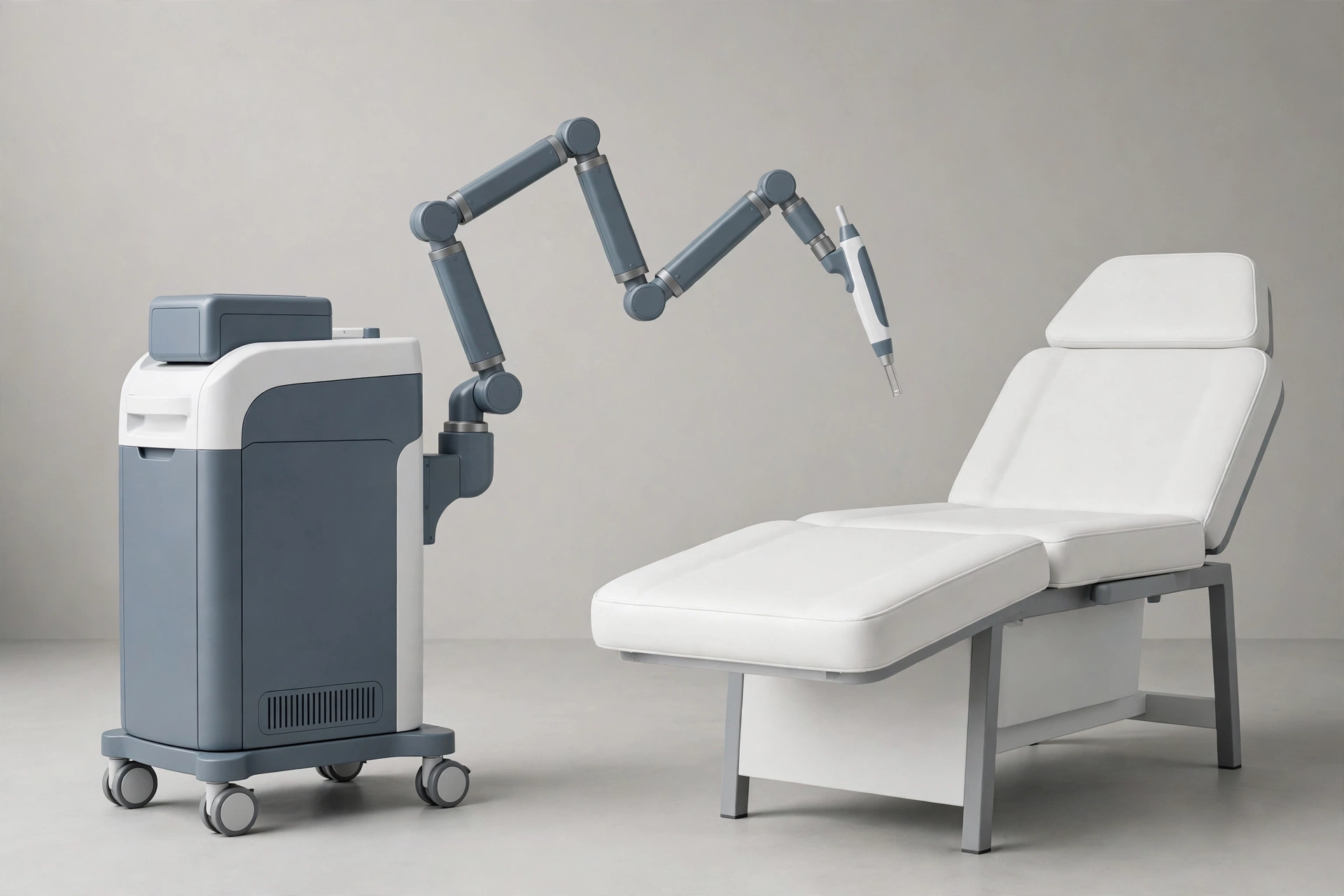
Illustration of a Q-switched laser platform for tattoo removal
Different targets in the skin
A hair removal diode delivers millisecond pulses at 810 nm into the follicle, using the hair shaft's melanin to carry energy to the structures that grow hair; treatment is repeated across sessions as follicles cycle. A Q-switched Nd:YAG stores energy and releases it in very short pulses aimed at pigment particles — tattoo ink and pigmented lesions — fragmenting them into pieces small enough for the body to clear over the following weeks. Same building, same appointment book, completely different physics at the target.
Workflow comparison
Diode hair removal is a high-throughput service: large areas, contact cooling, repeat visits on a growth-cycle schedule, and a patient base that returns for years of maintenance. Tattoo removal is a programme service: fewer, longer consultations, progress photographed across sessions, and pricing structured per programme rather than per visit. Clinics adding the second platform usually find the Q-switched service raises the average revenue per patient even at lower volume, because tattoo removal patients are committed, multi-session clients.
Room planning differs too. The diode platform earns a dedicated high-turnover room; the Q-switched platform can share a room on scheduled days. Staffing overlaps — the same laser operator skill base covers both, with procedure-specific training per platform.
| Primary menu | Diode: hair removal · Nd:YAG: tattoo removal, pigmentation |
|---|---|
| Session pattern | Diode: growth-cycle series · Nd:YAG: clearance programme |
| Cooling | Diode: sapphire contact + TEC · Nd:YAG: per configuration sheet |
| Patient relationship | Diode: maintenance base · Nd:YAG: committed programme clients |
Buying sequence
For most clinics the diode platform comes first, because hair removal demand is broader and steadier. The Q-switched platform follows when the clinic wants the tattoo removal menu or when patients start asking for pigment work the diode cannot do. Distributors reverse the logic by territory: in markets where tattoo removal demand is underserved, the Q-switched platform can be the lead line. Either way, both platforms here come from one manufacturer, one documentation route and one inquiry — the tattoo removal clinic guide and the diode clinic guide cover the service design for each.
- Not either/or: the platforms serve different menus
- Diode first for most clinics; Nd:YAG as the programme-service addition
- Shared operator skill base across both platforms
- One manufacturer and documentation route for the pair
Two different physics, two different promises
The diode works by sustained, selective heating: millisecond pulses, contact cooling, energy absorbed by melanin in the hair shaft and conducted to the follicle's growth structures. Its promise is cumulative — a course of sessions, each thinning regrowth, ending in long-term reduction. The Q-switched platform works by shock: extremely short, high-peak pulses that fragment pigment particles — tattoo ink, dermal pigmentation — into fragments small enough for the body's clearance systems to remove over following weeks. Its promise is also cumulative but for the opposite reason: not repeated heating of a living target, but repeated shattering of an inert one, paced by how fast tissue can clear debris.
Because the mechanisms differ, so does everything downstream. Diode clients book courses measured in weeks between visits and judge results across seasons. Tattoo clients book programmes measured in months, watch individual sessions produce visible frosting and gradual fading, and judge results across a year or more. A clinic running both platforms is really running two different service philosophies under one roof — one maintenance-like and rhythmic, one project-like and patient.
Room planning and operator skills
The diode room is a throughput room: couch, cooling discipline, a steady operator rhythm, high daily utilisation. The Q-switched room is a consultation room as much as a treatment room — clients arrive with cover-up plans, fading goals for cosmetic tattooing, or artwork they have outgrown, and the conversation about sessions, spacing and incomplete-removal possibilities matters as much as the laser work. Operators cross-train well between the platforms technically, since wavelength discipline, eye protection and skin assessment habits transfer; what does not transfer automatically is the counselling style each menu demands.
Purchasing order usually follows revenue gravity. Hair removal is the larger, steadier market in most catchments, so the diode typically lands first and funds the business; the Q-switched platform follows when the clinic wants a second, differentiated menu that competitors without one cannot copy. Distributors modelling a territory should run the same logic per account rather than pushing pairs: a hair-removal-led clinic and a tattoo-led studio are different customers who happen to buy from the same catalogue page.
What a combined menu looks like commercially
Together the platforms let a clinic describe itself, truthfully, as a laser practice rather than a hair removal salon with a laser in the corner. Cross-referral inside the building becomes natural: the tattoo client whose next project is a hair removal course, the hair removal client whose wedding plans include fading an old tattoo first. Marketing spend stretches further because every campaign advertises a house with two specialisms. The caution is operational, not commercial: two platforms mean two protocol books, two training tracks and two maintenance relationships, and a small team should sequence the launches a season apart rather than diluting both in the same month.
Counselling styles: maintenance versus project
The deepest difference between the two platforms is neither wavelength nor price but the emotional shape of the service. Hair removal clients are buying a maintenance outcome — a smoother routine, a course that ends in upkeep — and they judge the clinic on consistency, punctuality and the absence of drama. Tattoo clients are buying a project with a personal history inside it: a name, a decade, a version of themselves they are editing. They judge the clinic on honesty about timelines, respect for the story, and visible evidence of progress. Staff who love one shape do not automatically love the other, and clinics staffing a combined practice should recruit and roster with that difference in mind rather than discovering, a year in, that their best diode operator dreads tattoo consultations and their tattoo counsellor finds diode lists monotonous.
One building, two reputations
A combined practice quietly manages two reputations that obey different rules. The hair removal reputation is built on consistency and spreads through routine recommendation — the colleague, the gym friend, the sister. The tattoo reputation is built on witness: before-and-after sequences, artists' endorsements, the visible patience of a long programme completed well. Marketing that confuses the two — shouting project-style transformation language at maintenance clients, or treating tattoo work as a commodity line — underperforms in both directions. The clinics that thrive with both platforms keep two voices, two content streams and two consultation scripts under one roof and one standard of honesty, and let the building's name stand for the standard rather than for either menu.
Ask for a configuration and quotation
Send your market, the products you are evaluating and your buying pattern — the reply covers configuration, documentation and commercial structure.
Send an inquiry