Laser Lipolysis for Clinics: Building the Body Contouring Service
Laser lipolysis gives an aesthetic clinic a minimally invasive body contouring treatment between its non-invasive sculpting menu and full surgical referral. This guide covers how clinics scope the service on the 980 nm lipolysis and vascular platform: patient selection, treatment planning, menu position and the questions to settle before ordering.
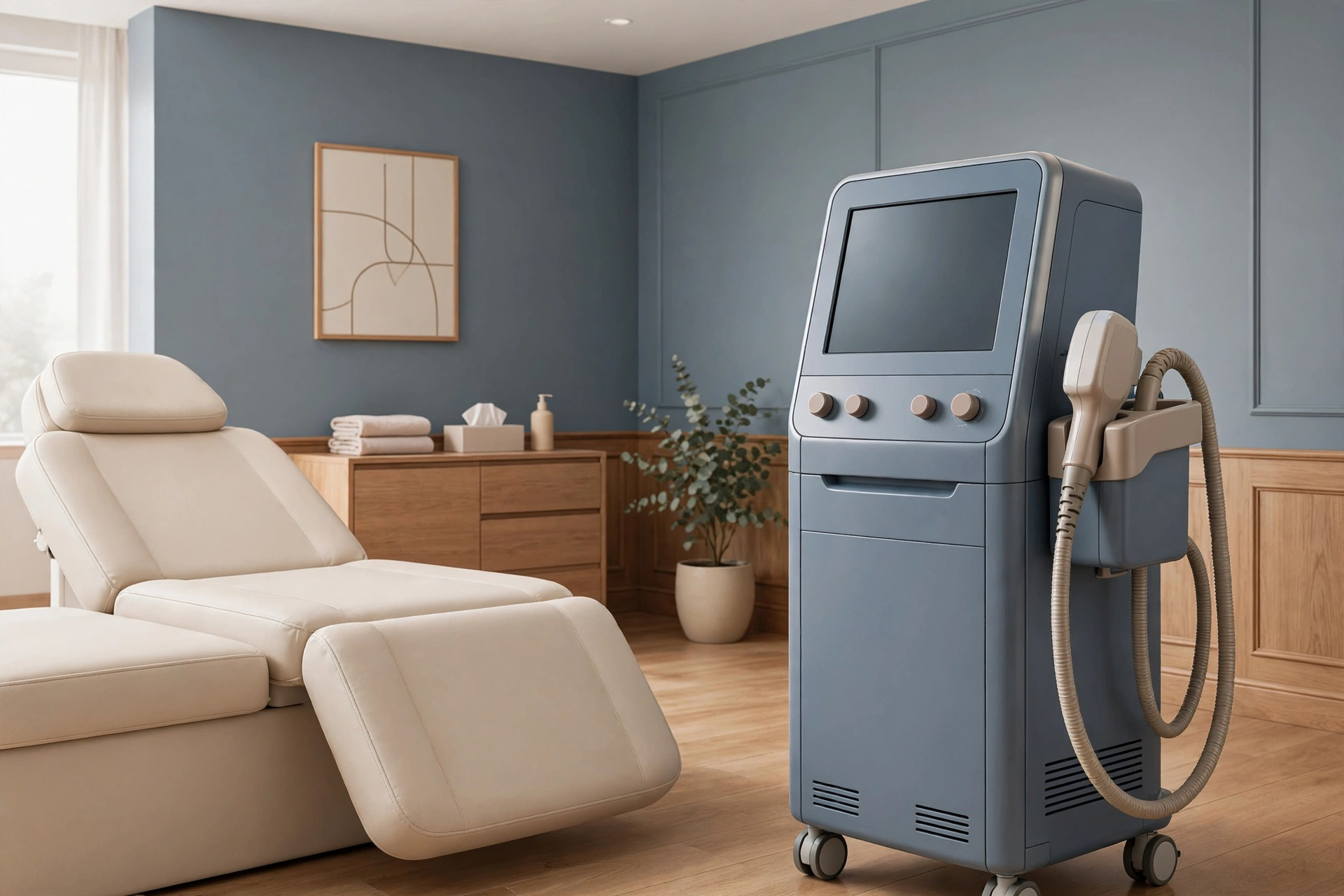
Illustration of a laser body contouring device
Where lipolysis sits in the menu
Patients divide roughly into those who want non-invasive shaping with no downtime, and those who want a decisive change in a specific area and accept a procedure to get it. Laser lipolysis serves the second group: laser energy delivered by fibre into the treatment area acts on the fat tissue, and the same procedure supports skin tightening in the treated zone. Positioned honestly, it does not compete with the clinic's non-invasive menu — it catches the patients that menu cannot satisfy, and it keeps them in the clinic instead of losing them to a surgical practice.
Patient selection and planning
The right candidate has localised deposits — chin and jawline, arms, abdomen, flanks, thighs — rather than a general weight problem, and lipolysis consultations should say so plainly. Planning covers the treatment areas, the number of areas per session, the recovery expectations and the follow-up schedule. The same 980 nm platform is positioned for vascular removal, so a clinic can plan a second procedure line on the same system once its clinicians are trained and its registration paperwork is in place.
Questions to settle before ordering
A fibre-delivered surgical-adjacent laser is bought differently from a hair removal platform. Settle the fibre and handpiece arrangement for your procedure list, the protocols and training the manufacturer supports, the documentation supplied for your market's registration of the device class, and the consumables pattern your volumes imply. Those answers are configuration-specific, so they come through the inquiry route with the current configuration sheet — this guide deliberately quotes no working parameters for the system, because the published positioning is the 980 nm platform and its applications, and the detail belongs in the manufacturer's reply to your procedure list.
- Sell lipolysis as the decisive step beyond non-invasive shaping
- Select patients on localised deposits, not general weight
- Plan vascular work as the second line on the same platform
- Settle fibre, training and registration questions pre-order
Designing a contouring programme clients complete
Body contouring succeeds or fails as programme design. The clinics that retain clients build a structure around the laser sessions: an assessment that records measurements and photographs under consistent conditions, a candid conversation about which areas respond and which disappoint, scheduled review points where progress is examined against the record, and lifestyle guidance that supports rather than moralises. The 980 nm platform supplies the treatment core — lipolysis and body contouring work delivered through fibre — but the programme wrapped around it is what clients describe to friends, and it is what justifies premium pricing in a market full of single-session promises.
Expectation-setting deserves its own ritual. Lipolysis refines contours; it does not substitute for weight loss, and it will not deliver a different body in a different dress size by Friday. Clients told this plainly, and shown the kind of change the clinic honestly produces, become the programme's advocates. Clients sold transformation become its critics, usually in public. The arithmetic of reputation is not subtle, and it compounds in whichever direction the first consultations point it.
Consultation, candidacy and the vascular conversation
Candidacy assessment sorts the diary into rewarding work and refunds-in-waiting. The right candidate has localised deposits that resist their general routine, skin quality that will redrape acceptably, and expectations calibrated to refinement. The wrong candidate is asking the laser to do a diet's job or a surgeon's. The platform's second application — vascular lesion work at the same wavelength — gives the consultation another register: clients presenting with visible vascular concerns can be assessed for treatment in the same room by the same team, and a clinic offering both should make sure its intake forms and consent language cover each distinctly rather than blending them into a generic laser conversation.
Pricing architecture matters as much as candidacy. Per-area pricing invites area-shopping; programme pricing — assessment, treatment series, reviews — frames the purchase as the outcome pathway it actually is. Clinics migrating from per-session habits usually find programme clients complete more, complain less and rebook adjacent services more, because the financial structure finally matches the clinical one.
Safety culture around a fibre-delivered treatment
A fibre-delivered lipolysis treatment is a clinical procedure, and the clinic's safety culture should read that way from the first leaflet to the last review. That means credentialled operators, a written protocol for the treatment sequence, honest discussion of recovery — clients plan around tenderness and downtime whether or not the brochure mentions them — and a follow-up rhythm that catches concerns while they are small. It also means resisting scope creep: the platform's positioning is lipolysis, contouring and vascular work, and the menu should stay inside what the team can defend in detail. In aesthetic medicine, the clinics that last are the ones whose ambition is visibly disciplined by their protocols.
The review appointment as a clinical instrument
Contouring results declare themselves slowly, and the review appointment is where the clinic manages the gap between biological time and client patience. Structure it as measurement, not reassurance: the same tape positions, the same camera distance and lighting, the same honest side-by-side photographs from the programme's start. Clients who can see incremental change in a record stop demanding it in the mirror every morning. Reviews are also where adjacent needs surface naturally — the vascular concern mentioned in passing, the second area the client has been considering — and a clinic that treats the review as a clinical instrument rather than a sales ambush finds those conversations arising without pressure, because the trust account is in credit.
Documenting the programme for the buyer's own file
A clinic importing a lipolysis platform should assemble its own evidence file at purchase rather than retrospectively: the manufacturer's positioning documents for the 980 nm system across both its applications, the treatment protocol as adopted and signed by the clinical lead, consent forms that name lipolysis and vascular work separately, and the training records of every operator. Distributors can accelerate a sale by preparing this skeleton for the buyer, but the clinic's name belongs on the finished file — regulators and insurers ask the operator, not the supplier, what governs the treatment room. Keeping the file live, with protocols versioned and reviews minuted, converts a one-off equipment purchase into a defensible clinical service, and it is remarkable how often the discipline of maintaining the file improves the treatments themselves, because what gets documented gets thought about twice.
Training and credentialing the contouring team
A contouring service should be delivered by a named, trained team rather than by whoever is free. Credentialing means documented training on the 980 nm platform for both its lipolysis and vascular applications, supervised first cases signed off by the clinical lead, and a clear boundary between what trained operators may treat and what escalates to senior review. Clients rarely ask to see these records, but they behave as though they can sense their existence — in the confidence of the consultation, the precision of the consent conversation, and the calm of the follow-up. Clinics expanding from a single operator to a team should treat the second operator's supervised ramp as a programme launch in miniature, because the service's reputation will thereafter be the average of everyone who delivers it, not the best of them.
Ask for a configuration and quotation
Send your market, the products you are evaluating and your buying pattern — the reply covers configuration, documentation and commercial structure.
Send an inquiry