Milestone Smart-M Compact Diode Laser Hair Removal System
The Milestone Smart-M puts the Milestone diode parameter set into a compact benchtop unit of 437×355×233 mm and 18.2 kg. It works at an 810 nm nominal wavelength through a 10×10 mm spot with fluence from 1 to 40 J/cm², and it is FDA 510(k) cleared for hair removal and permanent hair reduction across Fitzpatrick skin types I–VI, including tanned skin — the same cleared window as the floor-standing Standard-A, in a format a single practitioner can move between rooms.
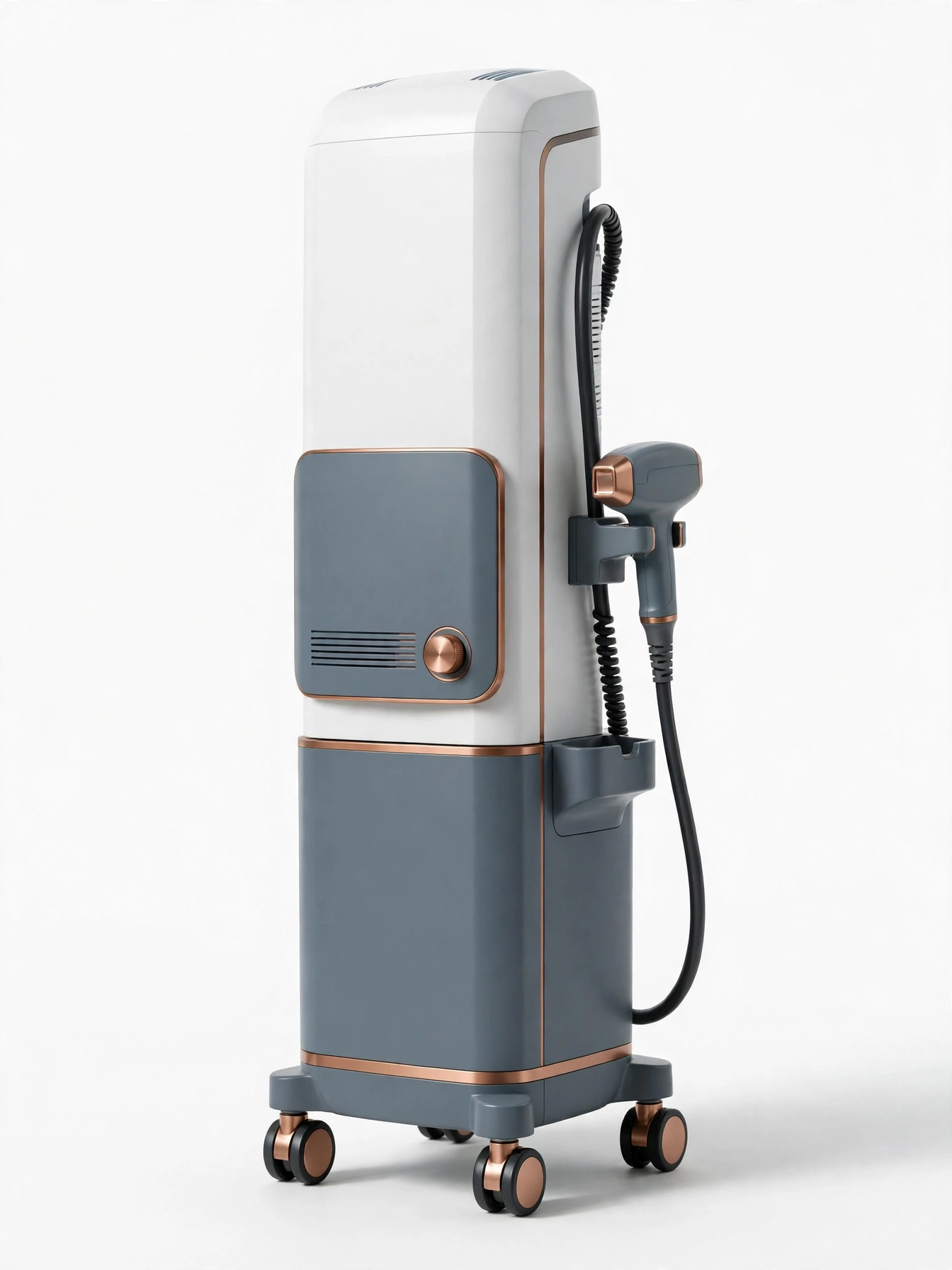
Illustration of a diode laser hair removal platform
Published parameters
The Smart-M shares the Milestone diode platform's treatment parameters with the Standard-A; the difference is the housing, not the treatment window.
| Laser type | Diode laser, Class IV |
|---|---|
| Wavelength | 810 nm nominal (±10 nm) |
| Spot size | 10 × 10 mm (1.0 cm²) |
| Fluence | 1–40 J/cm² |
| Pulse duration | 3–160 ms |
| Frequency | 1–10 Hz |
| Cooling | Sapphire contact cooling + TEC (thermoelectric) |
| Power supply | AC 100–240 V, 50/60 Hz, 1500 VA |
| Dimensions | 437 × 355 × 233 mm |
| Weight | 18.2 kg |
| Operating environment | 5–30 °C, humidity ≤ 80% |
| Storage environment | 5–55 °C |
Regulatory standing
The Smart-M is FDA 510(k) cleared as a diode laser hair removal system for medical use, for hair removal and permanent hair reduction on Fitzpatrick skin types I–VI, including tanned skin, at the 810 nm nominal wavelength, 10×10 mm spot and 1–40 J/cm² fluence. It is a standalone, prescription-use device. The clearance is scoped to this model and the Standard-A; it does not extend to any other product family in the range.
The compact-format case
A benchtop system changes the economics of adding hair removal to a practice. There is no dedicated room to build out, no floor-standing footprint to plan around, and at 18.2 kg the unit can be carried between treatment rooms or between sites in a salon group. For a solo practitioner or a salon adding laser hair removal beside an existing beauty menu, the Smart-M delivers the same cleared treatment window as the floor-standing system without the installation project.
The trade-off is throughput format, not treatment range: a clinic running back-to-back full-body lists all day will still prefer the floor-standing Standard-A's service format. Buyers who expect to grow into high volume often start with the Smart-M for a first room and add a Standard-A for the main list — the parameter protocols carry over unchanged between the two.
Before you order
The Smart-M runs on a standard AC 100–240 V supply and needs a stable bench or trolley position with clearance for cooling airflow. Send your inquiry with your treatment menu and expected daily volume, and the reply will confirm the configuration, the documentation pack and the service route for your market.
- Benchtop footprint suits salons and small clinics
- Same cleared parameter window as the Standard-A
- Ask for the format comparison sheet if you are undecided
The bench-top workflow, hour by hour
At 437×355×233 mm the Smart-M claims about as much bench as a monitor and keyboard, and at 18.2 kg one practitioner can relocate it without a second pair of hands or a trolley convoy. That mobility changes scheduling: the same unit can open the day in a treatment room, cover a midday consultation-room demonstration, and finish in a second site across town. Small clinics buy one platform and stretch it across their whole week instead of anchoring it to a single room's diary.
Setup discipline stays refreshingly short. The unit runs from a standard AC 100–240 V, 50/60 Hz supply, so there is no dedicated electrical work, no three-phase conversation with a landlord, and no facilities project standing between delivery and the first paying appointment. For a leased premises or a salon working inside someone else's building, that absence of installation friction is often the difference between launching a hair removal menu this quarter and postponing it indefinitely.
Same window, smaller box — what that means clinically
Buyers sometimes assume a compact format hides a reduced treatment offer. Here the published window is identical to the floor-standing model: 810 nm nominal emission, a 10×10 mm spot, fluence from 1 to 40 J/cm², pulse durations of 3–160 ms and repetition from 1 to 10 Hz, with sapphire contact cooling supported by thermoelectric cooling. The Fitzpatrick I–VI indication, tanned skin included, applies to this unit in its own right. A practitioner can therefore write one protocol book for the business and apply it whichever room the machine is working in.
The practical consequence shows up in consultation language. Staff do not need one explanation for the big room and a apologetic second version for the small one; the treatment story, the course structure and the expected timeline stay uniform. Clients moving between locations of a small group meet the same platform and the same parameters, which quietly reinforces the impression of a considered, standardised service rather than improvised equipment choices.
Who should choose the floor-standing model instead
The Smart-M is the wrong purchase when a room runs back-to-back body-area lists all day, every day, with two operators tag-teaming one console; that diary is the Standard-A's home ground. It is also the wrong purchase as a status object for a flagship reception area, since it was designed to work rather than to pose. Its natural owners are single-room clinics, salon groups adding a medical-grade menu, mobile or multi-site practitioners, and distributors building a demonstration fleet that has to travel in an ordinary car. For those buyers the relevant comparison is not against the flagship but against leaving the menu unoffered for another year.
Multi-site and mobile practice patterns
The Smart-M's weight class invites a working pattern the floor-standing world cannot copy: one platform, several premises. A practitioner running two part-time locations can hold a single training standard, a single protocol book and a single service relationship while the unit travels between sites on a rota the diary team controls. The disciplines that make this work are mundane — a transport case that protects the handpiece properly, a setup checklist taped inside the lid, a rule that the unit is never booked at two sites on the same day, and a session log that records location as well as settings, so the clinical record stays continuous even though the room changes. Groups piloting a second location often start exactly this way, proving demand with a travelling compact before committing to fixed installations anywhere.
Resale, redeployment and the long second life
Compact professional platforms enjoy a second life that floor-standing flagships rarely do. A Smart-M that opens a clinic's first room can become the satellite unit when the flagship arrives, the demonstration machine when the owner takes on a distributorship role, or the spare that keeps a diary alive during another unit's service week. That redeployment flexibility has real balance-sheet value: the purchase is not a single bet on a single room's future but a movable asset whose role evolves with the business. Buyers comparing headline prices between a compact and a larger console should credit the compact with this optionality — modest in any single year, considerable across the decade a well-kept platform can serve.
Ask for a configuration and quotation
Send your market, the products you are evaluating and your buying pattern — the reply covers configuration, documentation and commercial structure.
Send an inquiry