Laser Hair Removal for All Skin Types
Treating every patient who walks in — across the full Fitzpatrick scale, including tanned skin — is a specification question before it is a marketing one. This guide explains which platform in this range carries which skin-type indication: the Milestone diode systems are cleared for Fitzpatrick I–VI including tanned skin, while the alexandrite line is positioned for hair types I–IV, and the two ranges are never blended.
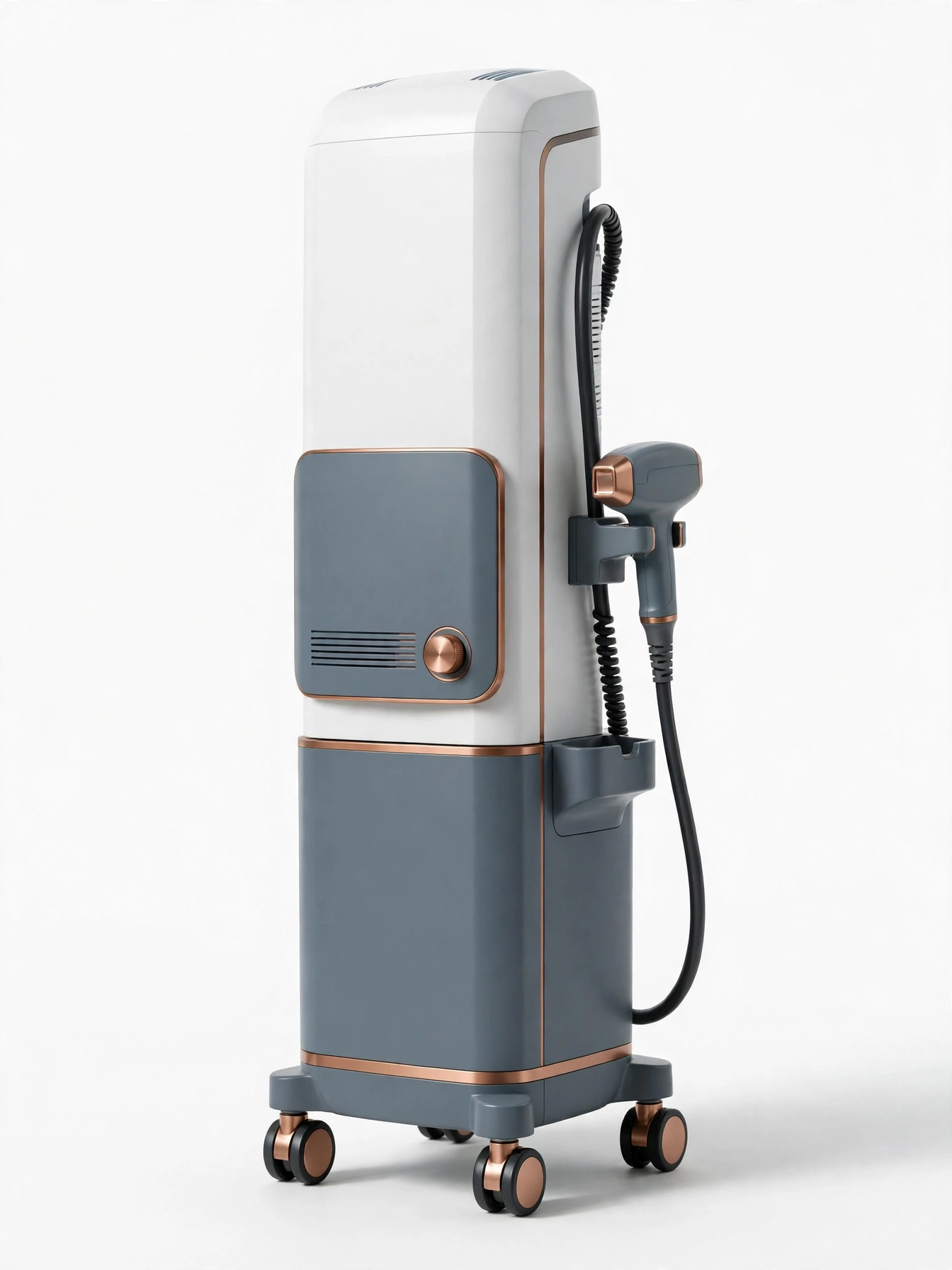
Illustration of a diode laser hair removal platform
Why wavelength decides the skin-type range
Laser hair removal works because melanin in the hair absorbs the laser energy. Skin melanin absorbs it too, and the balance between the two is what sets a platform's safe skin-type range. At 755 nm the absorption is stronger — excellent for light skin with dark hair, riskier as skin melanin rises. At 810 nm the absorption is lower and the energy penetrates deeper, which is the physical basis for treating darker and tanned skin when the pulse duration and cooling are managed correctly. Pulse duration matters alongside wavelength: longer pulses give the epidermis time to shed heat while the follicle still accumulates it, and the Milestone pulse range of 3–160 ms exists for exactly that protocol work.
The indications, stated precisely
The Milestone Standard-A and Smart-M are FDA 510(k) cleared for hair removal and permanent hair reduction on Fitzpatrick skin types I–VI, including tanned skin. That is the broadest indication in this range, and it belongs to those two models only. The Alex 755 is positioned for hair types I–IV — a deliberate, narrower range that reflects the 755 nm wavelength's behaviour, not a weaker machine. A clinic that treats the full local population needs the diode's indication on its main platform; a clinic whose patients are concentrated in the lighter types can run the alexandrite as its specialist and still cover its mix.
Tanned skin deserves its own sentence because it is where clinics most often over-promise. The Milestone indication includes tanned skin explicitly, which means the platform and its protocols are cleared for that case; clinicians still assess tan depth and adjust fluence and pulse duration conservatively, because an indication is a boundary of evidence, not a promise that every setting suits every patient.
Building a full-range menu
The practical build is: diode platform as the full-range base, alexandrite added where the lighter-skin segment justifies a specialist. Patient assessment stays individual — skin type, hair colour and density, tanning status and treatment area feed the protocol on either platform. The dark-skin and tanned-skin guide goes deeper on protocol thinking for the higher Fitzpatrick types, and the comparison page sets the two platforms' parameters side by side.
- Full-range and tanned-skin work belongs on the 810 nm diode
- Alexandrite's I–IV range is a specialism, not a shortcoming
- Pulse duration and cooling are part of the skin-type story
- Indications are model-specific — check the model, not the brand
How clinics structure a mixed-population menu
A clinic serving the full Fitzpatrick range organises itself differently from a single-population practice. Consultation templates record skin type, tanning history and hair characteristics as a matter of routine rather than exception. Pricing is published per area, not per skin type, so no client feels the menu was written for somebody else. Marketing photography and language speak to the whole catchment. These are small decisions, but together they signal that breadth is the clinic's identity rather than an accommodation it makes reluctantly — and clients from groups accustomed to being the exception notice the signal immediately.
Operationally, the broad-indication platform becomes the default room, and specialist platforms slot in around it. The diode carries the general list; the alexandrite, where owned, takes the lighter-skin clients who prefer it or whose hair responds best to it. Staff learn to present this as a matched choice — 'for your skin and hair, this is the platform we recommend' — which is a stronger consultation than offering one machine and a shrug.
Tanned skin: the protocol conversation
The Milestone indication includes tanned skin, and that phrase deserves careful handling in the consultation room. It means the platform's cleared window contemplates treating clients whose skin carries a tan — with the parameter discipline, test-spot judgement and timing conversations that responsible practice applies around recent sun exposure. It does not mean sunburned skin is treatable, or that holiday timing is irrelevant; clinicians still ask when the tan was acquired, how the skin reacted, and whether a cautious first session is the right opening move.
Handled this way, the breadth of the indication becomes a trust asset rather than an advertising slogan. Clients who have been refused elsewhere — sometimes curtly — respond to a clinic that assesses rather than rejects, explains the reasoning in plain terms, and documents the plan. That experience is frequently what converts a single cautious booking into a full course and a stream of referrals from the same community.
What breadth does not excuse
A broad indication is not a licence for uniform parameters. The same window that permits treating type VI skin obliges the operator to use it differently there: fluence judgement, pulse-width selection and cooling attention all shift with melanin content, and the platform's published ranges exist precisely to make that adjustment possible. Clinics should also be honest about hair, not only skin: very fine, pale hair responds weakly to any melanin-targeting platform on any skin type, and saying so at consultation — with alternatives discussed — protects both the client's money and the clinic's reviews. Breadth, used well, is a clinical discipline before it is a marketing line.
Training for breadth: competency across the range
A clinic claiming the full Fitzpatrick range must be able to prove its operators are competent across it, and competence is not evenly distributed by default — most practitioners' early experience clusters in the skin types their training clinic happened to serve. A deliberate programme corrects the skew: supervised lists across types with the lead clinician, case reviews that deliberately select type V and VI treatments for discussion, and a rule that no operator works unsupervised on a skin type until their supervised record covers it. This is slower than a blanket sign-off and considerably more defensible. It also produces the clinic's best marketing asset, though it should never be framed that way internally: a team whose confidence with every client who walks in is earned, documented and real.
When breadth meets its honest limits
A full-range clinic still meets cases it should decline or defer, and naming them protects the breadth claim's credibility. Active skin conditions in the treatment field, recent isotretinoin histories that house policy excludes, hair too pale for melanin targeting to reward, and expectations no platform could satisfy — each deserves the same respectful, documented refusal whatever the client's skin type. Breadth is about removing ancestry and pigmentation from the list of reasons a clinic says no; it was never about abolishing clinical judgement. Teams that understand the distinction market the range confidently and practise it safely, and their consultation records show a pattern sceptics find persuasive: refusals distributed by case facts, never by clientele.
Ask for a configuration and quotation
Send your market, the products you are evaluating and your buying pattern — the reply covers configuration, documentation and commercial structure.
Send an inquiry