DentaLase Dental Diode Laser
DentaLase is a 2-in-1 diode dental laser working at 810 and 980 nm, offered at 7 W and 10 W. Pulse duration runs from 1 ms to 10 s across continuous-wave and pulsed operation, energy is delivered by fibre with 200–1000 µm tips, and the published application set is soft-tissue surgery, therapy and teeth whitening.
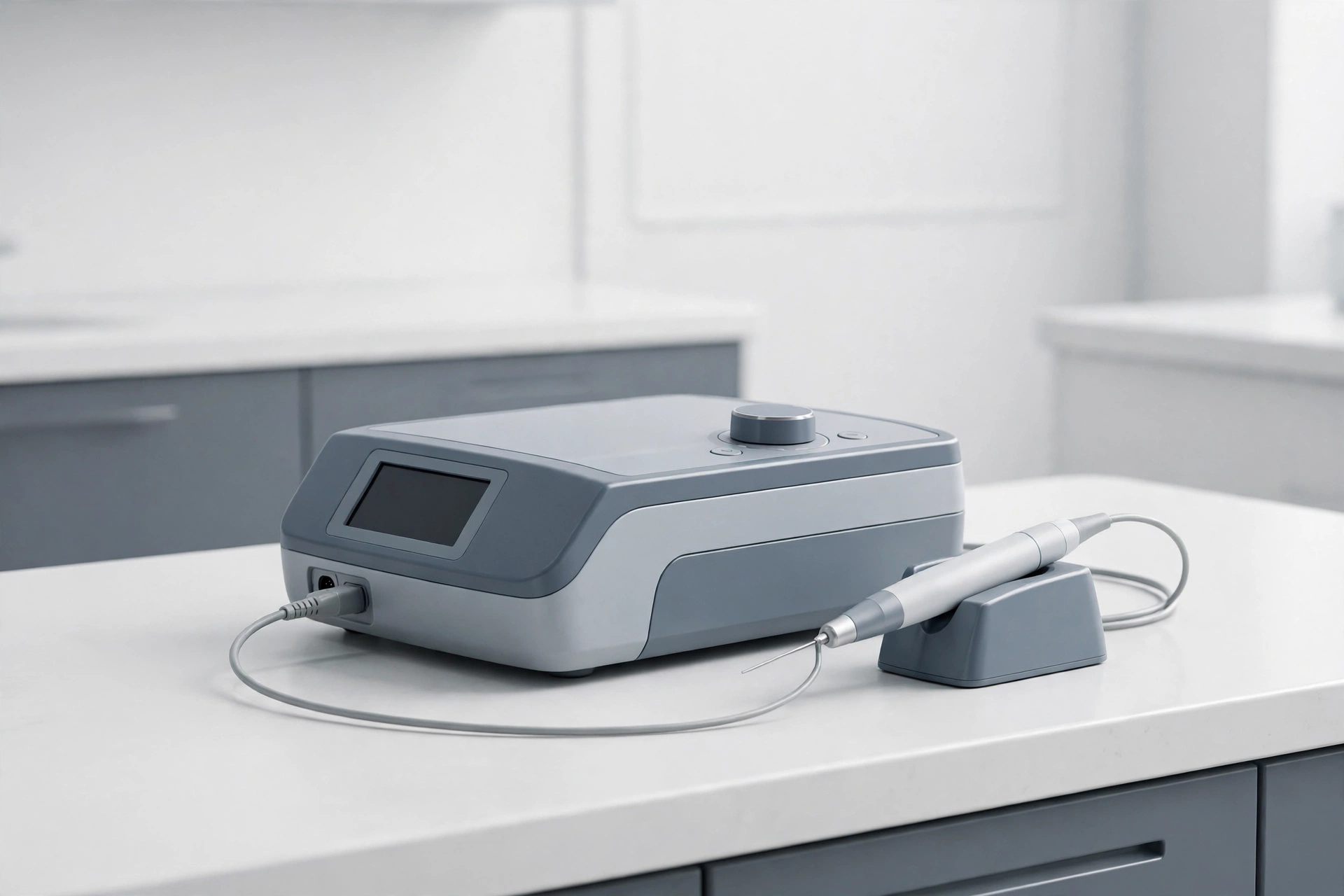
Illustration of a dental diode laser console
Published parameters
The parameter table below is the manufacturer's published specification for the DentaLase, modelled as the 2-in-1 Diode Dental Laser.
| Model form | 2 in 1 Diode Dental Laser |
|---|---|
| Wavelength | 810 & 980 nm (dual wavelength) |
| Power | 7 W, 10 W |
| Pulse duration | 1 ms – 10 s |
| Operation modes | CW, Pulse (0–1 kHz) |
| Transmission | Fibre, 200–1000 µm |
| Tips | Disposable / autoclavable, 200–1000 µm optional |
| Rating | 12 V DC, 5 A |
Applications as published
Three application groups are published for the DentaLase. Soft-tissue surgery is the core: the diode wavelengths cut and coagulate oral soft tissue with the haemostasis that makes laser dentistry attractive for gingival and lesion work. Therapy covers pain relief, anti-inflammation and wound healing after surgery — the low-level side of the platform that practices schedule into post-operative care. Teeth whitening is the cosmetic application, using the laser as the activation source in whitening procedures.
The dual-wavelength design is the practical point of the device. One fibre platform covers the surgical list in the morning and therapy and whitening appointments later in the day, and the 7 W and 10 W options let a practice size the unit to its procedure mix. Pulse control from 1 ms to 10 s across CW and pulsed modes gives the clinician the exposure control that soft-tissue work requires.
Selection guidance
Practices should choose the power option against their procedure mix: a surgery-led practice will use the 10 W headroom; a therapy-and-whitening-led practice may find the 7 W unit sufficient. Tip inventory is the other planning point — the 200–1000 µm fibre range covers the standard soft-tissue tip set, and tips are disposable and autoclavable, so consumable supply belongs in the first order conversation. Send your procedure mix through the inquiry form and the reply will recommend a power option and a starter tip set.
- Dual wavelength in a single fibre platform
- Surgery, therapy and whitening in one device
- Disposable, autoclavable tip workflow
- 7 W and 10 W options sized to procedure mix
A day in surgery with two wavelengths
Picture the running order of an ordinary list. The morning opens with a soft-tissue procedure — a gingival contouring case where the 810 nm emission does the cutting and the operatory stays calm because the field is managed fibre-tip by fibre-tip. Midday brings therapy appointments: a post-surgical patient returning for pain-relief and anti-inflammation support, treated at low intensity with the handpiece held at a distance from the dressing. The afternoon closes with whitening sessions, the diary's reliable fillers, where the laser-assisted protocol gives the hygienist a premium service to offer at recall visits. One platform, three different conversations with three different patients — that spread is the business case in miniature.
The dual-wavelength design earns its place inside that day. Having 810 and 980 nm in one unit means the clinician selects emission characteristics per indication rather than owning two single-purpose boxes or referring work away. The fibre delivery, in diameters from 200 to 1000 µm, scales the working end from fine periodontal pockets to broader surgical fields, and the disposable autoclavable tips keep the infection-control story simple to explain to patients and inspectors alike.
Governance, training and the learning curve
Adding a laser to a dental practice is a governance exercise before it is a clinical one. Someone must own the safety file: protective eyewear matched to the wavelengths in use, a controlled area during emission, warning signage, a usage log, and documented training for every clinician who will fire the device. The published pulse repertoire — continuous wave, pulsed operation from 1 ms to 10 s, repetition to 1 kHz — gives the trainer concrete material: which modes belong to surgery, which to therapy, and which settings are never to be improvised. Practices that write these rules before the first patient tend to reach confident, boring, safe routine within weeks.
The learning curve itself is gentler than newcomers fear, because the fibre tip gives tactile feedback much like a probe and the procedures extend skills a dentist already owns — incision, ablation, disinfection adjuncts, photobiomodulation — rather than replacing them. Starting with whitening and therapy builds hand familiarity at low stakes; surgical indications follow once the team's routines are automatic. Choosing the 7 W or 10 W configuration should follow the intended case mix: a therapy-and-whitening practice rarely needs the higher ceiling, while a surgery-heavy list will use it.
Talking to patients about laser dentistry
Patients do not buy wavelengths; they buy less dread, quicker healing and fewer visits. The honest consultation vocabulary for this platform is therefore experiential: soft-tissue work with managed bleeding and tidy fields, therapy aimed at pain relief and calmer post-operative days, whitening delivered as a defined in-chair programme. What the consultation should avoid is miracle language — the laser is an instrument, not an anaesthetic revolution, and over-claiming corrodes the trust that a multi-visit treatment plan depends on. A practice that explains plainly, treats conservatively and reviews outcomes will find the device recommending itself through the oldest channel in dentistry: one patient telling another that it was all much easier than expected.
Building the business case inside a general practice
The finance conversation for a dental laser should be held in the practice's own numbers, not the supplier's. Count the soft-tissue procedures currently referred out or managed conventionally each month; count the post-surgical reviews where therapy could shorten the story; count the whitening enquiries the front desk currently deflects. Against those counts, set the acquisition cost of the 7 W or 10 W configuration, the tip and consumable spend the fibre system implies, and the training investment in clinician hours. Most general practices find the case rests less on any single hero procedure than on the accumulation of small recoveries — referrals kept in-house, appointments that become shorter, a hygiene department with a premium service to sell. A case built that way survives sceptical partners, because every figure in it came from the practice's own diary rather than a brochure's optimism.
Integrating the laser into the hygiene department
The hygiene department is where a dental laser quietly multiplies its value. Whitening programmes give hygienists a premium service that fits recall appointments; therapy applications extend what a maintenance visit can offer patients recovering from procedures; and the department's patient relationships — often the longest in the practice — make it the natural channel through which laser services are explained and booked. Principals should involve the hygiene lead in the purchase decision itself, not merely in the training that follows it, because a department that helped choose the platform schedules it with conviction, while one handed an unfamiliar device as a surprise tends to let it gather the particular dust reserved for other people's ideas.
Ask for a configuration and quotation
Send your market, the products you are evaluating and your buying pattern — the reply covers configuration, documentation and commercial structure.
Send an inquiry