Laser Hair Removal for Dark and Tanned Skin
Dark and tanned skin is where hair removal platforms separate into those with the indication and those with the advertising. The Milestone diode systems are cleared for Fitzpatrick types I–VI including tanned skin; this guide explains the protocol thinking behind that indication — wavelength behaviour, pulse duration, fluence discipline and cooling — and where the alexandrite range's boundary honestly sits.
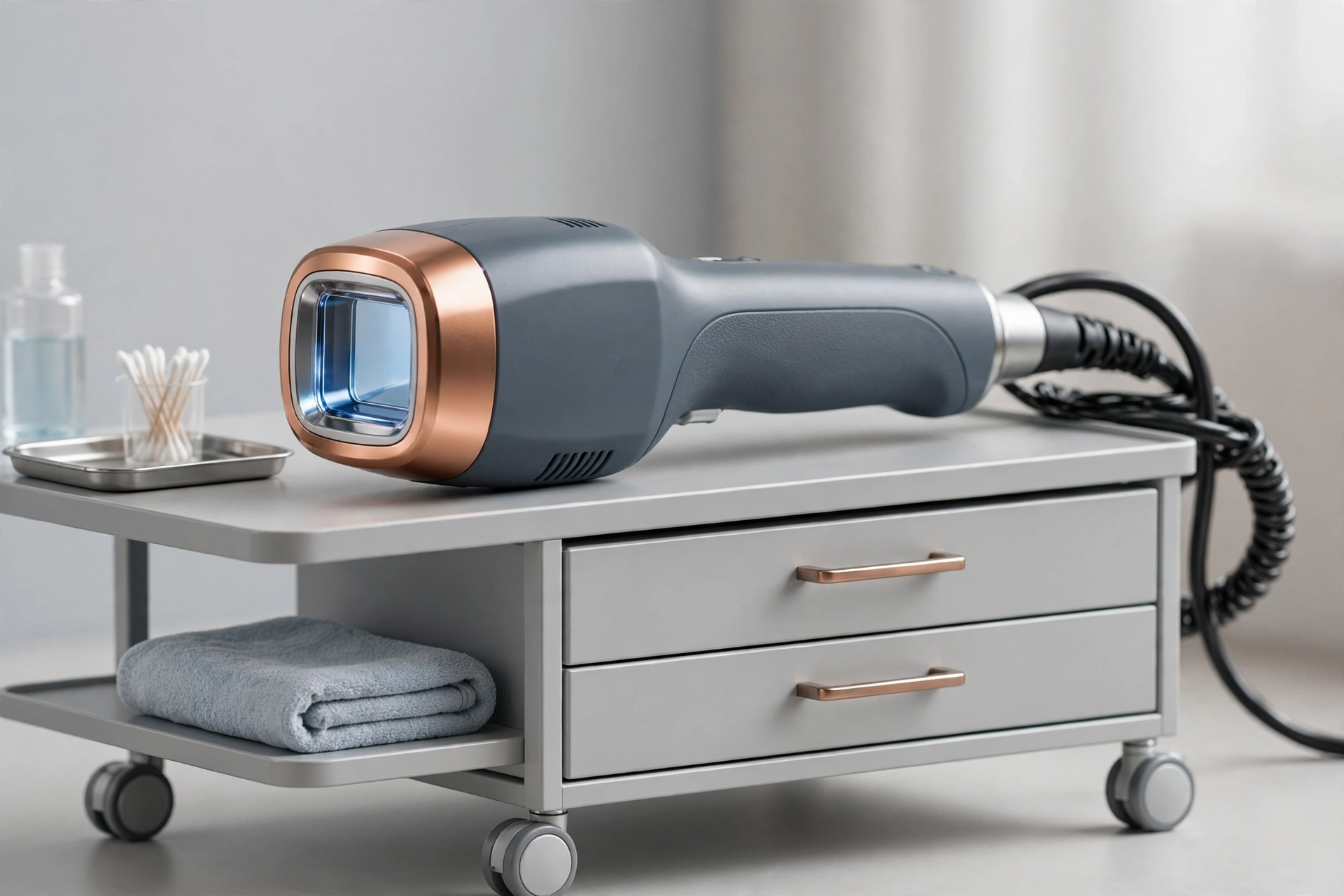
Illustration of a diode laser handpiece resting on a clinic cart
The physics of darker skin
In darker skin, epidermal melanin competes with the hair follicle for the laser's energy. The defence is threefold. Wavelength: 810 nm is absorbed less aggressively by epidermal melanin than 755 nm while still targeting the follicle. Pulse duration: longer pulses let the thin epidermis release heat between the moments of peak energy while the thicker follicle structure retains it — the Milestone range runs to 160 ms for this work. Cooling: the sapphire contact window with TEC support cools the surface before, during and after the pulse. A platform that offers all three, inside a cleared indication, is a platform engineered for the full Fitzpatrick range.
Protocol discipline
The indication sets the boundary; the clinician sets the treatment. For higher Fitzpatrick types and for tanned skin, conservative fluence with longer pulse duration is the working pattern, test spots precede full-area treatment, and tanning status is assessed at every visit rather than assumed from the last one. The Milestone fluence window of 1–40 J/cm² gives room to work low and build across a session series as the skin's response is observed. None of this is a substitute for training — it is the reason the platform's parameter ranges are published in full on the detail pages, so a clinic's medical lead can judge the protocol space before purchase.
What not to do
Do not treat dark or freshly tanned skin on a platform whose indication stops earlier in the scale, however the listing is worded. In this range, the Alex 755 is positioned for hair types I–IV, and this site does not stretch that boundary in copy — clinics with a mixed population run the diode as the full-range platform and the alexandrite as the lighter-skin specialist. Do not blend the two ranges in patient-facing promises either: the honest menu says which platform treats which skin types, and patients trust it more for saying so.
- 810 nm, long pulses and contact cooling are the dark-skin toolkit
- Work low in the fluence window and build across sessions
- Re-assess tanning status at every visit
- Keep each platform inside its own stated indication
Why darker skin was historically underserved
The early decades of laser hair removal belonged to light skin, for physical reasons this guide has explained: melanin absorbs the energy, and epidermal melanin in darker skin competes with the follicle for it. Early platforms with limited pulse control and weak cooling made treatment of types V and VI genuinely risky, and many clinics simply declined. Two developments changed the position — delivery systems that can stretch pulses and moderate peak epidermal heating, and contact cooling that protects the surface while the follicle receives its dose. The Milestone pair's published combination of long pulse options, sapphire contact cooling and TEC support sits squarely in that second generation of design, and its cleared indication follows accordingly.
The legacy of the earlier era is a client base that often arrives expecting refusal. A clinic equipped and trained for the full range is therefore not merely adding capacity; it is entering a market its competitors may still be vacating, with word-of-mouth dynamics that reward the first credible provider in an area.
Assessment habits that protect outcomes
Good outcomes on darker skin are built before the handpiece is lifted. The assessment records recent sun exposure and tanning behaviour, any history of post-inflammatory hyperpigmentation from other causes, current skincare that might sensitise the skin, and the hair's calibre and density in the treatment zone. Test spots, read after an appropriate interval rather than impatiently, tell the clinician how this individual's skin negotiates energy — information no population-level guideline can replace. Consent language should name the specific pigmentary risks honestly; clients who feel their skin was taken seriously become meticulous about the aftercare that keeps results clean.
Parameter philosophy follows from the same caution: begin conservatively, respect the platform's longer pulse options, lean on the cooling, and escalate across sessions as the skin demonstrates tolerance. The temptation to chase visible immediacy — the client asking why a first session felt gentle — should be answered with the plan, not with the fluence control. Documenting each session's settings against the skin's response turns a course into a record the whole team can learn from.
Aftercare and the pigment conversation
Aftercare on darker skin is largely pigment management: rigorous sun protection over the treated area, patience with the normal shedding timeline, no aggressive exfoliation while the skin settles, and a clear route back to the clinic if mottling or darkening appears. Most pigmentary responses, when they occur, are temporary and manageable — but only if the client reports them early rather than treating them at home with lightening products bought online. The consultation that explains this calmly, in advance, converts a potential complaint into a demonstration of professionalism. Clinics should also photograph under consistent conditions at each visit; on darker skin, gradual change is easy to doubt and documentation settles doubt kindly.
Building the clinic's reputation in an underserved market
Reputation in this segment travels through community channels with unusual speed, in both directions. A clinic that treats darker-skinned clients carefully and well acquires advocates whose recommendations carry the weight of personal verification — 'they treated my skin properly' is a sentence with few equivalents in aesthetic marketing. The reverse travels just as fast, and a single careless outcome, handled defensively, can close a community to a clinic for years. The commercial strategy follows directly: invest disproportionately in the first cohort's experience, invite feedback explicitly, respond to concerns faster than the protocol requires, and let the reputation compound. This is slow marketing, and it is also the only kind that cannot be outbid by a competitor's advertising budget.
Ask for a configuration and quotation
Send your market, the products you are evaluating and your buying pattern — the reply covers configuration, documentation and commercial structure.
Send an inquiry