Diode Laser Cooling: Sapphire Contact, TEC and Ice Cooling
Cooling is not an accessory on a hair removal laser — it is half the treatment. This guide explains the cooling arrangement on the Milestone diode systems (sapphire contact cooling with thermoelectric support), why contact cooling suits the full Fitzpatrick range, and what the 'ice cooling' label refers to where it appears elsewhere in this range.
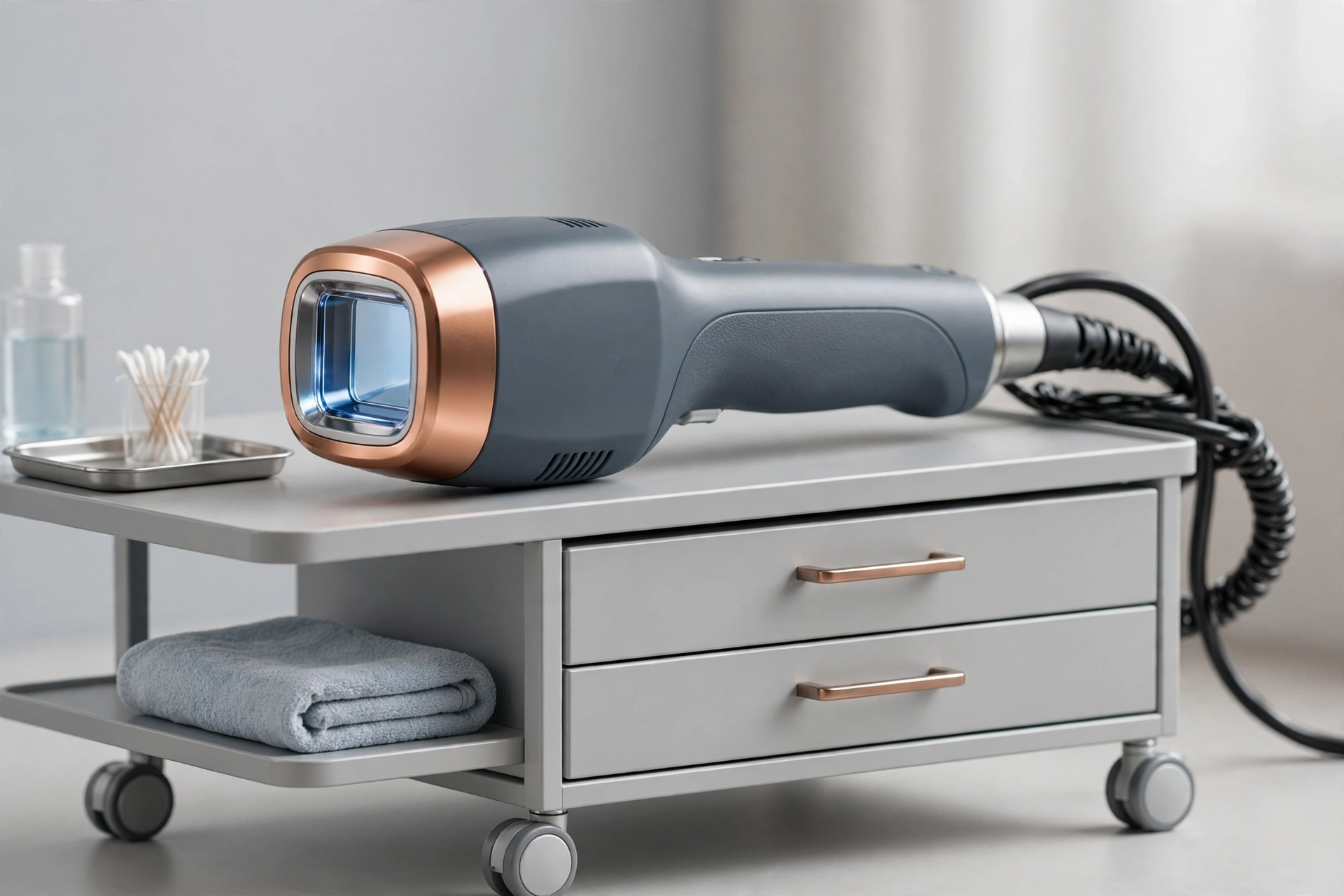
Illustration of a diode laser handpiece resting on a clinic cart
Sapphire contact cooling
The Milestone handpiece presents a sapphire window to the skin. Sapphire is used because it conducts heat exceptionally well for an optical material: the window is held cold, it sits in contact with the skin before and during the pulse, and it draws heat from the epidermis at exactly the surface the laser energy must cross. Contact matters — a pressed, cooled window cools continuously rather than in a single instant, and it also flattens the treatment area slightly, which evens out the optical path into the follicle.
What the TEC adds
TEC — thermoelectric cooling — is the refrigeration engine behind the window. A thermoelectric module pumps heat away from the sapphire and holds the window temperature steady across a long treatment list, where passive cooling would drift as the system warms. The pairing of sapphire contact and TEC is the diode platform's answer to the dark-skin problem described in the skin-type guides: longer pulses protect the epidermis in time, and the cold window protects it in temperature, so the follicle can be treated firmly without the surface paying for it.
And 'ice cooling'?
Buyers searching this range will meet the phrase 'ice cooling' in the market, often attached to diode machines as a comfort claim. Inside this manufacturer's own range, the ICE Cooling System label belongs to the MagicEYES RF eye care device, where cooling frames the radio-frequency treatment steps — it is not a diode handpiece technology and it is not claimed for the Milestone systems. The Milestone cooling claim is the published one: sapphire contact cooling plus TEC. Keeping those labels separate is deliberate; cooling claims should name the mechanism, and the mechanism here is contact sapphire with thermoelectric support.
- Judge cooling by mechanism, not by label
- Contact cooling works before, during and after the pulse
- TEC holds window temperature across a full list
- The ICE label in this range belongs to MagicEYES
Cooling as a clinical variable, not a comfort feature
It is tempting to file cooling under client comfort, one line in a brochure between the touchscreen size and the warranty. That undersells it. Cooling decides how much energy the epidermis tolerates while the follicle receives its dose, which means it participates in the treatment's central trade-off — efficacy against safety — on every pulse. Contact cooling through a sapphire window draws heat from precisely the surface being treated, before, during and after emission; the thermoelectric system behind it holds that window at temperature across a long list, so the fortieth client of the day meets the same thermal conditions as the first. When a clinician compares platforms, the cooling question is therefore not 'is it cooled?' but 'how is the cooling held steady under load, and how would I know if it faltered?'
That last clause matters operationally. A clinic's pre-list checks should include the window's condition and the cooling's behaviour, because degraded cooling announces itself subtly — clients reporting more sting than usual at familiar settings — before it announces itself in an adverse event. Treating those reports as data rather than temperament is the mark of a mature laser service.
Sapphire, honestly appraised
Sapphire earns its place in the window for physical reasons: it conducts heat far better than ordinary glass, it is hard enough to resist the scratches that cloud lesser windows and scatter energy unpredictably, and its optical clarity keeps the delivered fluence honest across years of service. None of that is magic, and sapphire windows still demand care — cleaning with the right materials, inspection for residue baked on by inattentive sessions, and protection from the knocks that happen when handpieces meet trolley edges in a hurry. A window is a consumable with a long life rather than a permanent fixture, and clinics should know its replacement route and cost before they need either.
The contact format itself shapes technique. Pressure, angle and glide speed all influence how uniformly the window couples to the skin and therefore how evenly energy is delivered; a new operator's first supervised lists are largely about hands, not settings. Clinics training staff should say so plainly, because operators who blame parameters for what their hand position caused will chase settings in circles while the actual variable goes uncorrected.
Cold, colder, and the limits of both
Clients occasionally equate stronger cooling sensation with better treatment, and some platforms in the wider market lean into theatrical cold as a selling point. The clinician's answer is physiological: cooling protects the epidermis and manages sensation, but the follicle still needs its thermal dose, and over-aggressive surface cooling paired with timid fluence produces comfortable, ineffective sessions — the worst bargain in the industry. The Milestone arrangement, sapphire contact with TEC backing, is best understood as controlled moderation: the surface held in a safe band while fluence does its work at depth. Marketing language that reduces this to a temperature boast misses the design's actual virtue, which is steadiness — hour after hour, client after client, the same cool window meeting the skin.
What clients feel, and what to tell them
Client sensation is data wrapped in anxiety, and cooling sits at the centre of how it is interpreted. The honest briefing before a first session describes the sequence plainly: the cool window against the skin, the pulse's brief sting, the way both repeat across the treatment field, and the normal post-session warmth that fades within hours. Clients briefed this way report the same physical sensations as unbriefed clients but rate them as milder and worry less — expectation is an analgesic in its own right. Clinics should also invite mid-session feedback as a matter of script, because the client who feels able to say 'that area is more sensitive' gives the operator information that protects the result, while the client who silently endures teaches the clinic nothing except, eventually, through a review it did not want.
Cooling failures: recognition and response
Protocols should name the response before it is needed. If cooling performance degrades mid-list — clients reporting unusual sting at familiar settings, the window failing to feel cold at the pre-session check, visible condensation behaving oddly — the operator stops, documents, and escalates rather than compensating by feel. Treatment resumes only when the cause is identified or the platform is swapped. Writing this down matters because the pressure of a full waiting room argues eloquently for carrying on, and a prior written rule is the only team member who never feels that pressure. Clinics should log every such event, however minor its resolution; a pattern across months is service information the manufacturer needs and the clinic's future self will be grateful to have.
Ask for a configuration and quotation
Send your market, the products you are evaluating and your buying pattern — the reply covers configuration, documentation and commercial structure.
Send an inquiry