Q-switched Nd:YAG Laser Price: Cost Factors for Tattoo Removal Systems
Tattoo removal systems are quoted per configuration, so a single headline price would be invented rather than informative. This guide sets out what actually drives the cost of a Q-switched Nd:YAG platform — configuration, treatment-head arrangement, documentation, training and service — so a clinic can structure its inquiry and read quotations properly.
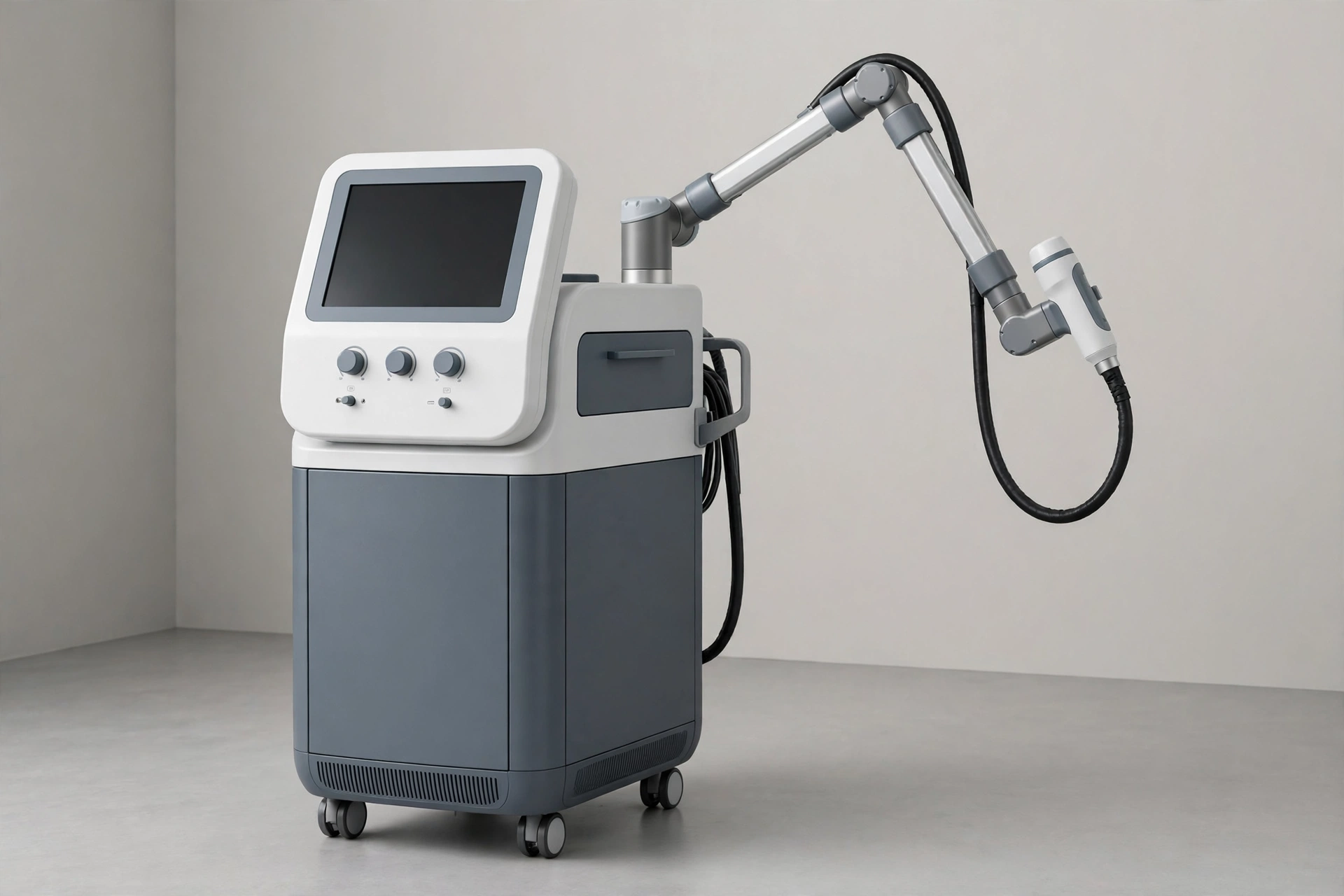
Illustration of a Q-switched laser device for tattoo removal
Configuration comes first
A Q-switched platform bought for tattoo removal alone is configured differently from one bought to run pigmented-lesion work in the same clinic, and the price follows the configuration. Treatment heads, delivery arrangement and the control interface are chosen against the menu, which is why this site asks about your planned services before quoting rather than publishing a figure that would silently assume a configuration you may not want. The clinic setup guide describes the menu decisions that feed the configuration.
Documentation, training and service
For a medical laser, the machine is only part of the purchase. The documentation supplied for your market's registration process, the operator training route and the service arrangement over the system's life are real cost components — sometimes bundled into the system price, sometimes separated, always worth itemising when you compare quotations from different suppliers. A low headline price with documentation and training stripped out is not the same product as a complete quotation. Ask every supplier, including this one, to itemise: system and configuration, documentation pack, training, service terms and the spare-parts route.
How to get the figure
Send the inquiry form with your market, your planned menu (tattoo removal, pigmented lesions, or both) and whether the platform joins an existing laser room. The reply will quote the configured system with the items above made explicit, so your clinic can budget the whole purchase rather than discover its parts later.
- Never compare headline prices across different configurations
- Itemise documentation, training and service in every quote
- Menu decisions come before configuration decisions
- Budget the whole purchase, not the machine alone
Why tattoo platform prices scatter so widely
Buyers comparing Q-switched platforms meet a bewildering price spread, and the spread has structure once you know where to look. At the bottom sit compact units aimed at beauty-salon tattoo fading, with modest energy delivery and minimal documentation. At the top sit medical platforms with articulated arms, substantial pulse energy, calibrated delivery and regulatory files that support clinical marketing claims. Between them lies a crowded middle where specification sheets inflate creatively — peak-power figures quoted in ways that flatter, spot sizes without fluence context, and wavelength lists padded with accessory handpieces of narrow usefulness. The buyer's defence is to price against a defined job: the tattoo work actually expected, in the setting actually planned, under the claims the business actually intends to advertise.
This catalogue's positioning should be read in that light. The Q-switched Nd:YAG platform here is presented for professional clinic tattoo removal and pigment work, quoted per configuration through inquiry — which places the pricing conversation where it belongs, after the buyer's setting and case mix are understood, rather than in a public number that would mean different things to a hospital group and a single-room studio.
The costs after the console arrives
Ownership costs for a tattoo platform have their own shape. Articulated arms and their optics ask for careful handling and periodic professional attention; a knocked arm is the classic self-inflicted expense of this category, and clinics should budget for the service relationship accordingly. Consumables are lighter than in some categories — no gels, modest disposables — but protective eyewear rated for the platform, replacement windows or tips where the design uses them, and calibration checks belong in the annual figure. Training carries unusual weight too: tattoo work is consultation-heavy, and the cost of an undertrained operator is paid in client disputes rather than in parts.
Revenue modelling should respect the programme structure of the service. Income arrives across many months per client, sessions are short, and the diary value concentrates in consultation quality and retention rather than machine hours. A platform that looks expensive per session-hour can be cheap per completed programme if its reliability keeps a two-year client book intact — and a bargain unit that falters mid-programme strands revenue that no refund policy fully recovers.
Questions that expose a weak quotation
Ask what the pulse energy is at the handpiece, not at the source, and at which spot sizes the quoted fluence figures hold. Ask which components the warranty names explicitly — lamp or source, arm optics, handpiece — and which it silently excludes. Ask what documentation accompanies the platform for the buyer's own market, and whether the supplier's stated positioning (professional clinic use) matches the paperwork supplied. Ask who services the arm, where, and with what turnaround, because the answer locates the platform's true support geography. A quotation that survives these questions with consistent, written answers has earned comparison on price; one that dissolves into adjectives has told the buyer everything necessary.
Distributor arithmetic for a specialist line
For a distributor, a Q-switched line is a portfolio decision rather than a product decision. The line will never match diode volumes; its value lies in the accounts it opens and the baskets it enlarges — the clinic that comes for tattoo removal and stays for the wider catalogue, the studio segment no competitor's diode-only range can address. Territory modelling should therefore count doors and basket expansion, not only unit margin: how many credible tattoo-led accounts exist in the region, what a placed platform's service and consumables annuity looks like across five years, and what demonstration stock the line requires to sell at all. Judged on those terms, a specialist line often outperforms its modest unit forecast — provided the distributor staffs it with someone who understands the consultation-led sale, rather than folding it into a generalist's quota where it will always lose the internal competition for attention.
Trade-ins, upgrades and end-of-life honesty
Buyers entering the category through a first platform should ask, at purchase time, the questions usually postponed until they become awkward: whether the supplier operates any trade-in or upgrade path as the clinic's ambitions grow, what the expected service life of the light source and arm optics is under professional loads, and how end-of-life units are handled when their day finally comes. A supplier's fluency on these unglamorous subjects correlates strongly with the quality of support in between, because it reveals whether the relationship is designed as a lifecycle or as a transaction. Recording the answers in the purchase file costs nothing and converts future negotiations from archaeology into reference.
Ask for a configuration and quotation
Send your market, the products you are evaluating and your buying pattern — the reply covers configuration, documentation and commercial structure.
Send an inquiry