Alexandrite Laser Hair Removal Equipment Price: What Drives It
Alexandrite platforms sit at the professional end of hair removal pricing, and the spread between quotations is explained by identifiable factors: the laser platform itself, the pulse control range, the DCD cooling arrangement and its consumables, and the format. This guide works through them against the Alex 755's published specification.
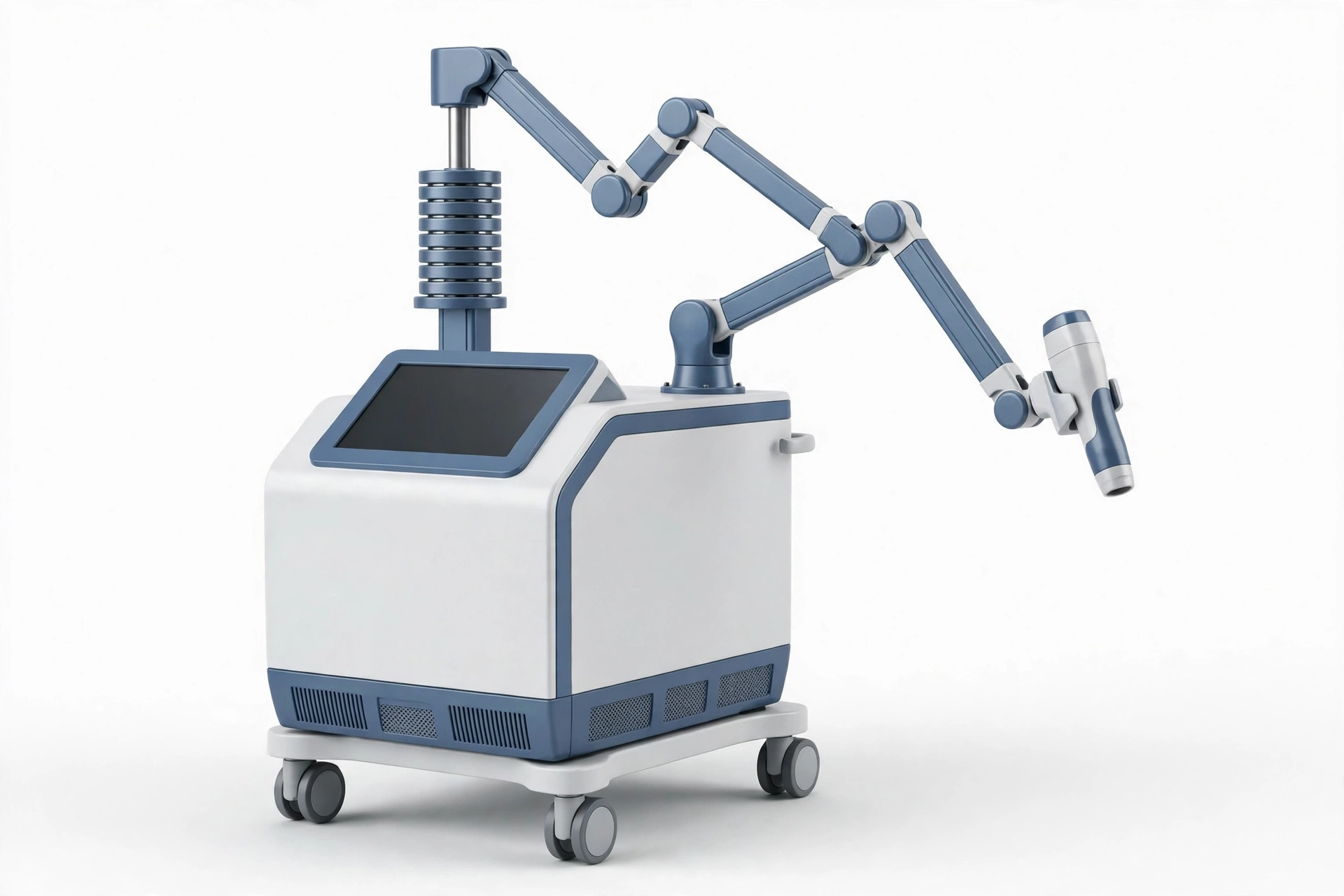
Illustration of an alexandrite laser hair removal platform
The platform factors
An alexandrite system's price starts with its laser engine and its control range. The Alex 755 publishes 2000 W of laser power, fluence from 0 to 100 J/cm², pulse widths from 3 to 200 ms and repetition rates of 1–10 Hz, run from an 8-inch HD touch screen. Wider control ranges and higher sustained power cost more to build and are worth more in the room, because they are the protocol space your clinicians work in. When comparing quotations, align these four numbers first; a cheaper platform with a narrow fluence or pulse range is a smaller tool, not a better deal.
The cooling consumable
DCD cooling protects the skin with a cryogen spray, and the cooling medium is a running consumable that belongs in the total cost model from the start. Ask how the quotation treats it: initial supply included or not, resupply route in your market, and consumption per treatment list. Contact-cooled diode platforms carry no equivalent consumable, which is one of the structural cost differences between the two families — the comparison page sets the platforms side by side if you are deciding where the money works harder for your patient mix.
Format and quotation
The alexandrite range includes the parameterised Alex 755 and the water-free Gentle and Pro formats; format and configuration move the final figure, as do the documentation and service structure for your market. Send the inquiry form with the format you are evaluating, your market and your patient mix, and the reply will quote the configured system with its documentation pack and service arrangement stated — a number you can compare honestly against the diode alternative.
- Align the four control numbers before comparing prices
- Put the DCD consumable in the running-cost model
- Format (Alex 755 / Gentle / Pro) moves the figure
- Quote against your patient mix, not a generic configuration
What the alexandrite premium actually buys
Alexandrite platforms sit at a premium against entry-level diode equipment, and buyers deserve a precise account of the difference. Part is the gain medium and its engineering: a 755 nm system built for clinical fluence delivery is not a repurposed diode stack. Part is the cooling architecture — dynamic DCD cooling is a consumable-fed system with its own hardware, timing electronics and running costs, engineered because the alexandrite's clientele and pulse structure reward exactly that protection. Part is positioning: the platform serves hair types I–IV as a specialist, and specialist instruments in every branch of medicine price against the value of doing one defined job exceptionally rather than all jobs adequately.
The published Alex 755 figures frame the value concretely: 2000 W of laser power capacity, fluence adjustable across 0–100 J/cm², pulse widths from 3 to 200 ms, repetition to 10 Hz, delivered through a non-contact handpiece format with an 8-inch control screen. Whether that specification earns its premium depends entirely on the buyer's clientele — which is why this guide insists on profiling the patient list before admiring the machine.
Running costs unique to the format
The DCD system converts cooling into a metered consumable, so the alexandrite's cost per session carries a line item the diode room does not have. Clinics should model canister consumption per treatment at their expected case mix, price it into the menu, and track actual usage against the model — drift in either direction is diagnostic, of waste or of under-cooling discipline. Against that cost, set the savings the non-contact format returns: no gel purchase, no gel laundry, faster room turnover, and a treatment field the operator can see. An honest five-year model nets the two, and the net figure, not the consumable alone, is what belongs in the platform comparison.
Service expectations should be set in the same conversation. Specialist platforms justify specialist support: response times, loaner policies during repairs, and the availability of engineers who know this category rather than lasers generally. A distributor evaluating the line for a territory should weigh the installed-base logic too — an alexandrite placed into the right lighter-hair clinic becomes a reference site whose results sell the next three placements.
When the premium is the wrong spend
Candour about the negative case protects buyers and, paradoxically, sells more alexandrite systems in the long run. If the clinic's population spans the full Fitzpatrick range, the diode's breadth should take the founding budget and the alexandrite should wait for the second-platform moment. If the diary is price-led rather than results-led, the premium will be squeezed out of the menu within a year. If the lighter-hair segment in the catchment is thin, the room will stand idle while a generalist platform would have been working. The premium is right — emphatically — for the clinic whose clients match the indication, whose pricing already lives at the specialist tier, and whose reputation strategy is to be the best answer for a defined population rather than an adequate answer for everyone.
Financing structures and their hidden terms
Premium platforms are frequently financed rather than bought outright, and the financing structure deserves the same scrutiny as the machine. Lease and rental arrangements should be read for their treatment of the DCD consumable supply, maintenance inclusion, and end-of-term ownership — a low monthly figure attached to a machine the clinic never owns, serviced by nobody in particular, is a different purchase from the one the brochure described. Buyers should also align the finance term with the platform's realistic revenue ramp: a specialist room takes a season to fill its diary, and structures with stepped early payments exist precisely because lenders who know this category understand its rhythm. The final figure to demand from any financing proposal is the total paid across the full term, set beside the outright price — the comparison is occasionally sobering, and making it is the difference between financing as a tool and financing as a fog.
The reference-site visit: what to watch
A reference visit repays a buyer's day when it is run as observation rather than entertainment. Watch a working list, not a demonstration: how the operator sequences the DCD-cooled pulses across a real treatment field, how the room turns around between clients, what the consumables rhythm actually looks like across a morning. Ask the owner the questions brochures cannot answer — what the first year cost beyond the invoice, which clients the platform turned away, what they would configure differently. Owners are often startlingly candid with a peer who asks precisely, and a single candid hour can recalibrate a five-year cost model more thoroughly than a month of specification comparison.
Ask for a configuration and quotation
Send your market, the products you are evaluating and your buying pattern — the reply covers configuration, documentation and commercial structure.
Send an inquiry