Adding a Dental Diode Laser to Your Practice
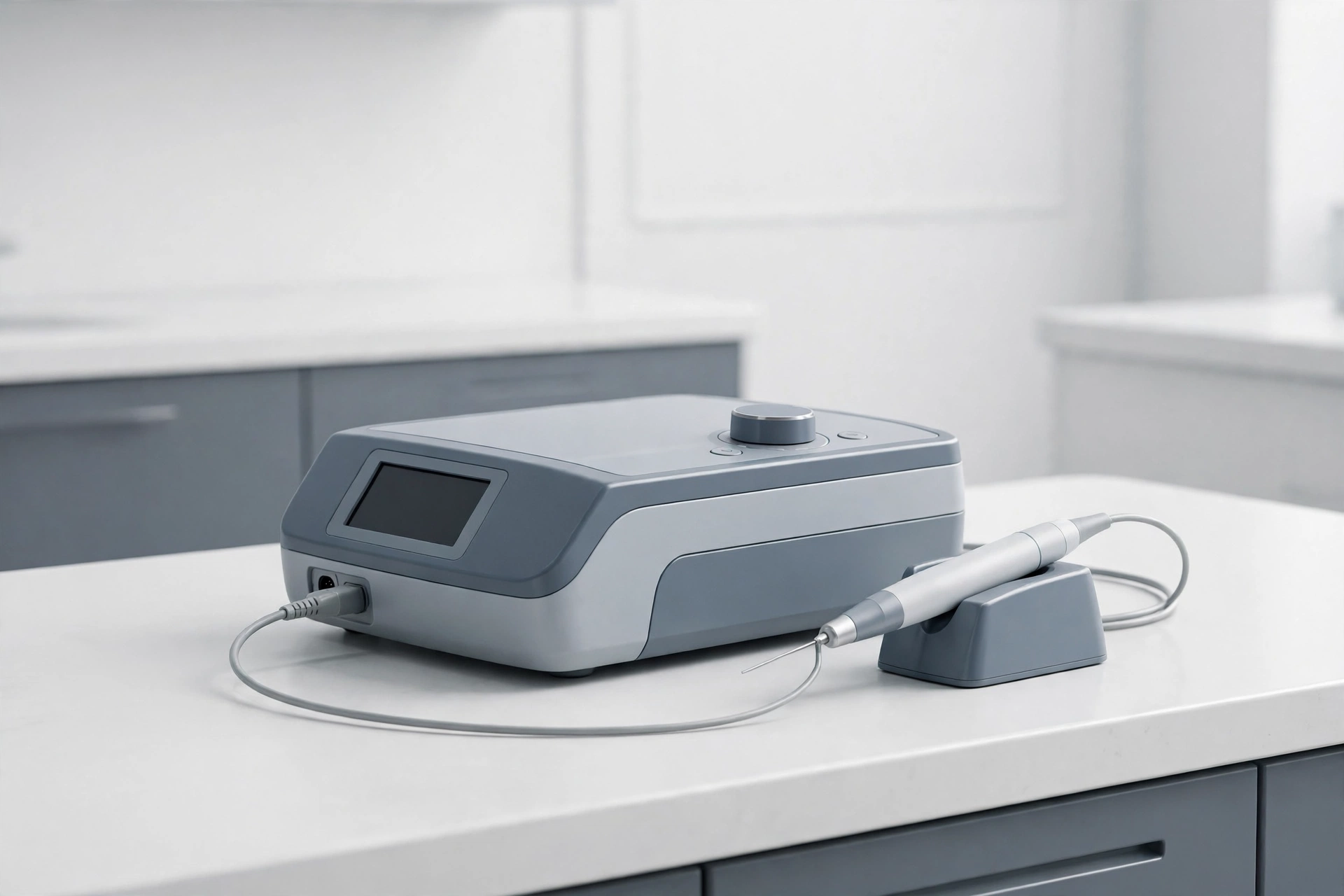
Dental diode lasers have moved from novelty to standard kit in practices that do regular soft-tissue work. This guide covers the practical case: what the laser actually changes at the chair, how the fibre workflow fits a surgery day, and how to size a dual-wavelength unit like the DentaLase to a practice's procedure mix.
The soft-tissue case
The core argument for a dental diode is haemostasis with precision. In gingival contouring, troughing for impressions, frenectomies, lesion removal and operculectomy, the diode cuts and coagulates in the same pass: the field stays visible, suturing often disappears from the procedure, and post-operative discomfort drops against scalpel work. For the practice, that converts to shorter appointments and a procedure list that patients accept more readily. A dual-wavelength unit — 810 and 980 nm in the DentaLase — lets the clinician choose the wavelength behaviour that suits the tissue in front of them rather than adapting every procedure to a single wavelength's habits.
Therapy and whitening fill the diary
Surgery alone rarely justifies any capital purchase; the diary fills when the same device works across the day. The therapy applications — pain relief, anti-inflammation and support for wound healing after surgery — schedule into post-operative care the practice already provides, and laser-assisted teeth whitening gives the platform a cosmetic list with strong patient demand. A device that works the surgical list in the morning, therapy reviews after lunch and a whitening appointment in the afternoon is a device whose cost per working hour falls fast.
The fibre workflow
Diode dental lasers deliver through optical fibre, with tips in the 200–1000 µm range covering the standard soft-tissue set. Tips are disposable and autoclavable, which keeps the infection-control story simple: prepare the tip, treat, dispose or sterilise per protocol. The practical planning points are tip inventory — stock the sizes your procedures actually use — and cleaving and preparation discipline, because a poorly prepared tip quietly degrades every procedure it touches. Build the tip check into the surgery setup routine and the platform will perform as specified.
Sizing the unit: 7 W or 10 W
The DentaLase is offered at 7 W and 10 W. A surgery-led practice — regular contouring, lesion and soft-tissue lists — should take the headroom of the 10 W unit, because cutting speed and coagulation confidence at the top of the range are what the surgical list consumes. A practice whose laser work is mainly therapy and whitening support will find the 7 W unit sufficient and should spend the difference on tips, training and marketing the new services instead. Either way, pulse control from 1 ms to 10 s across continuous and pulsed modes gives the exposure control that delicate oral tissue work requires — that control range, more than the headline wattage, is the specification to study.
Training and the learning curve
The diode learning curve is kind compared with most surgical technologies, but it is a curve. Clinicians new to laser soft-tissue work should expect a supervised ramp: observation, assisted procedures on the simpler indications — troughing, gingivectomy, whitening activation — and then the fuller surgical list as tip handling and exposure judgement settle. The variables that take practice are tactile: fibre angle, movement speed, the feel of contact versus near-contact work, and reading tissue response in real time. Practices that schedule the ramp properly, rather than handing the device to a full list on day one, reach confident utilisation in weeks; practices that skip it often park the device and conclude, wrongly, that the technology was oversold.
Safety and governance in the surgery
A dental laser is a surgical instrument and the practice's governance should treat it as one: wavelength-rated eye protection for everyone in the room during firing, a controlled operatory with the door signage your local rules require, a maintained log of procedures and settings, and tip inspection built into setup. Plume management during tissue work deserves the same seriousness as with any surgical energy device. None of this is onerous, and all of it is cheaper to build into the routine at installation than to retrofit after an incident review. Ask the manufacturer for the device-specific safety documentation with the purchase file, and file it where your clinical governance lead can find it — the same discipline this site applies to its own published claims applies to the operatory.
Building the business case
The arithmetic of a dental laser is procedure-led. List the soft-tissue procedures your practice already performs with a scalpel in a month, the ones you currently refer out, and the therapy and whitening appointments a laser menu would create rather than capture. The referral list is usually the surprise: work the practice was giving away becomes chair time at home. Against that revenue, set the unit, the tip inventory across your real procedure mix, training time for the clinicians who will use it, and the governance setup. Practices that run this table honestly usually find the utilisation question answers itself — the laser pays when it is scheduled like the workhorse it is, across surgery, therapy and whitening in the same week, rather than reserved for the occasional showcase procedure. Start the laser on the two or three indications your team already understands best, publish those to patients first, and let the menu widen with confidence.
First ninety days
A practical ramp for a practice new to the platform: weeks one and two for training, tip preparation discipline and governance setup, with the laser used on the clinician's simplest, most familiar indications. Weeks three to six for building the standing lists — whitening and therapy appointments are the natural diary fillers while surgical confidence grows. Months two and three for widening the surgical menu, publishing the new services to the patient base, and reviewing utilisation and tip consumption against the business case written at purchase. Practices that follow a ramp like this reach the point where the laser is simply part of how the surgery works — which is the entire goal. The practices that stall are almost never defeated by the technology; they skip the ramp, and the device becomes furniture. Schedule the ramp before the device arrives.
Ask for a configuration and quotation
Send your market, the products you are evaluating and your buying pattern — the reply covers configuration, documentation and commercial structure.
Send an inquiry