How Clinics Choose a Diode Laser Hair Removal System
A diode laser is usually the largest single equipment decision a young aesthetic clinic makes, and it is often made backwards: cabinet first, price second, clinical fit last. This article sets out the order experienced buyers use — indication, parameter space, format, documentation — and shows what each step actually decides.
Step one: the indication you can advertise
The first question is not about the machine at all. It is about the claim your clinic is allowed to make. A platform cleared for hair removal and permanent hair reduction across Fitzpatrick I–VI, including tanned skin, lets you build your menu, your consent forms and your advertising on the full patient population. A platform with a narrower indication — or with no documentation a medical lead can file — forces the clinic to shrink its promises or to make promises its paperwork cannot support. Write down the patient mix you actually expect: skin types, tanning patterns in your climate, hair colours. The indication has to cover that mix, in writing, before any other comparison begins.
This is also where honest boundaries help rather than hurt. If a segment of your mix belongs on a different wavelength — the lightest skin types on an alexandrite, for example — it is better to know at purchase time and plan the second platform than to discover it in refused consultations.
Step two: the parameter space
Fluence range, pulse-duration range, repetition rate and spot size are the clinical toolkit, and they should be compared as a set. A wide fluence window (the Milestone systems run 1–40 J/cm²) lets clinicians work conservatively on sensitive areas and firmly on coarse hair. A long pulse-duration ceiling (160 ms on the same systems) is the dark-skin tool: it lets the epidermis shed heat while the follicle accumulates it. The spot size sets the working rhythm — 10×10 mm is the balance point between large-area speed and small-area control for most clinics. Repetition rate matters less as a headline than as sustained performance: the question is whether the system holds its settings at the end of a full list, which is a cooling question as much as an electronics one.
Cooling deserves its own line in the comparison. Sapphire contact cooling with thermoelectric support cools the skin before, during and after each pulse and holds its temperature across the day. Whatever system you evaluate, ask for the cooling mechanism by name and think through what it means for your darkest-skinned patients, because that is where cooling stops being a comfort feature and becomes part of the safety system.
Step three: format follows the room
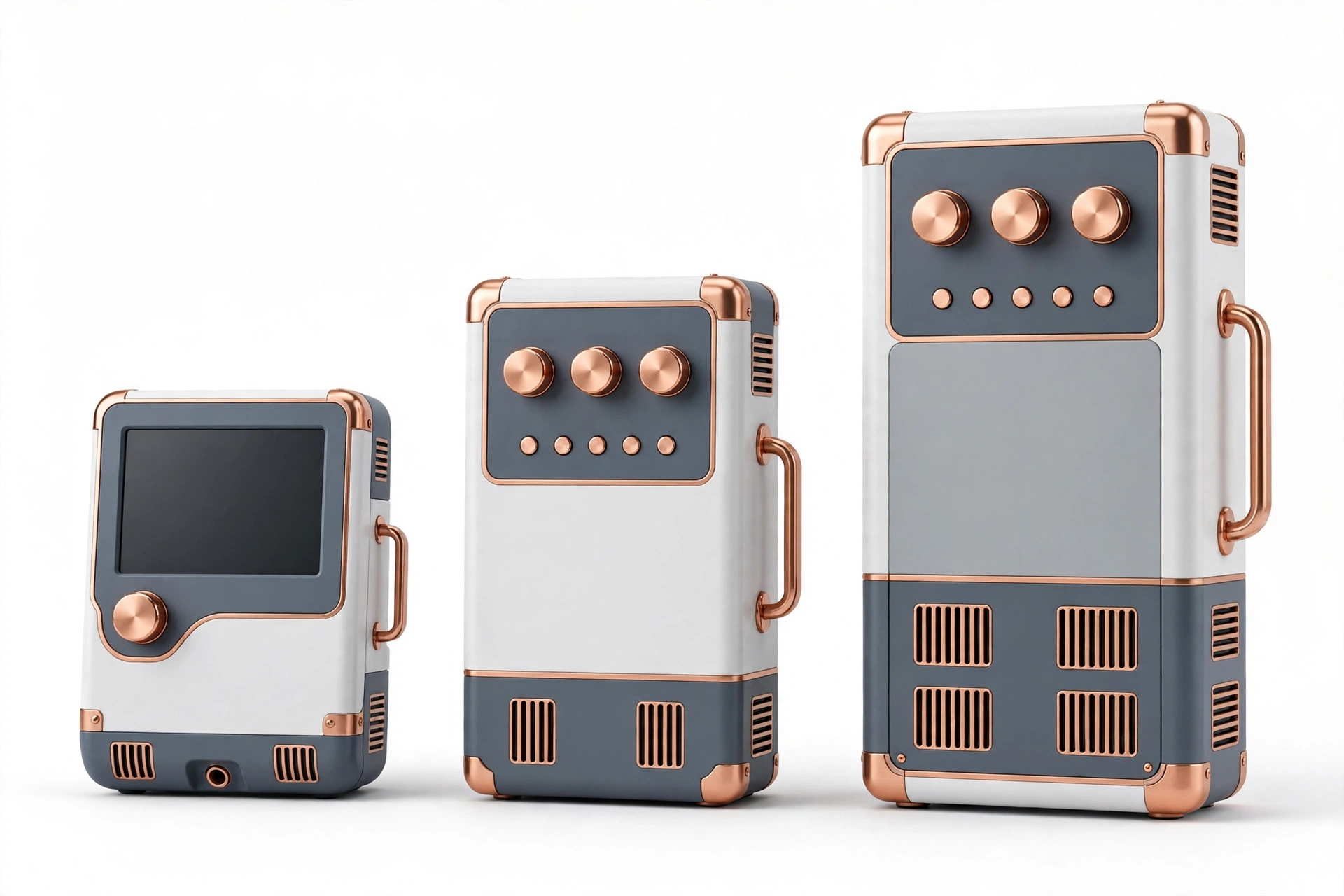
Only after indication and parameters should format enter the decision, and format is a workflow question. A dedicated laser room with a full list justifies the floor-standing system. A multi-use room, a second site or a salon-format business points to the benchtop unit — in this range the Smart-M carries the same cleared parameter window as the Standard-A in an 18.2 kg housing, which removes the usual penalty for choosing compact. Clinics planning growth often sequence the two: benchtop first room, floor-standing main list later, protocols unchanged between them.
Step four: documentation and the life after purchase
Close the decision on paperwork and support. What documentation ships with the system for your market's registration? What does the training route look like for your operators? What is the spare-parts path when the handpiece reaches end of life — because it will, and a machine without a parts route is a machine with an expiry date. Ask for the handpiece replacement answer in writing before you sign, not after the first failure. A complete answer to those four questions, from any supplier, is worth more than a small difference in the machine price.
The demonstration trap
Suppliers demonstrate machines beautifully. A demo unit arrives polished, the representative treats a cooperative patch of skin, and the handpiece feels light for eleven minutes. None of that predicts the third month: the full list on a hot day, the handpiece after its ten-thousandth pulse, the patient whose tanned skin tests the protocol discipline. Buy against the third month. Ask how the cooling system holds window temperature across a long list; ask what the handpiece service interval looks like and what a replacement costs in time as well as money; ask which parts of the machine your own engineer may touch and which return to the factory. The answers separate manufacturers from assemblers faster than any brochure.
It is also worth asking existing owners — not the references a supplier selects, but clinics you find yourself. Two questions matter: what broke, and how long did the fix take. Every platform has a failure story somewhere; the supplier's quality shows in the second half of the answer.
Total cost, honestly assembled
Build the five-year cost before you compare prices. The machine and its configuration are the start. Add the documentation and registration work your market requires, operator training for the staff who will actually run the lists, the consumables pattern of your chosen cooling and delivery system, the service arrangement after the first year, and one handpiece replacement across the period as a planning assumption. Set against that the revenue side at your realistic utilisation — not the brochure day, but your third-month Tuesday. Clinics that assemble this table routinely discover that the cheapest machine was the most expensive option on the page, and that the format decision (benchtop now, floor-standing later) changed the payback more than any discount negotiation.
None of this argues for buying the most expensive platform. It argues for buying the platform whose costs you have seen whole — and for treating a supplier who helps you assemble the table as a supplier behaving like a manufacturer should.
A one-page checklist
Compressed, the decision reads as follows. Indication: does the documentation cover your patient mix, in writing, including tanned skin if your climate demands it. Parameters: fluence window, pulse ceiling, spot and repetition — compared as a set, from the specification sheet. Cooling: the mechanism named, and its behaviour across a full list explained. Format: matched to your room model, with a growth path that preserves protocols and training. Documentation: the pack that ships, itemised, plus the training route for your operators. Ownership: service structure after year one, handpiece replacement cost and turnaround, parts availability in writing. Price: the five-year table, assembled whole, compared against realistic utilisation. A supplier who answers all seven lines cleanly has earned the order; a supplier who answers three and pressures you on the fourth has told you what the ownership years will feel like. Keep the checklist, score every candidate against it in the same sitting, and let the paper — not the demonstration — make the decision.
Ask for a configuration and quotation
Send your market, the products you are evaluating and your buying pattern — the reply covers configuration, documentation and commercial structure.
Send an inquiry